What Is Ataxia?
Ataxia is a neurological condition that affects balance, coordination, and controlled movement. It is often connected to problems in the cerebellum, the area of the brain that helps coordinate movement.
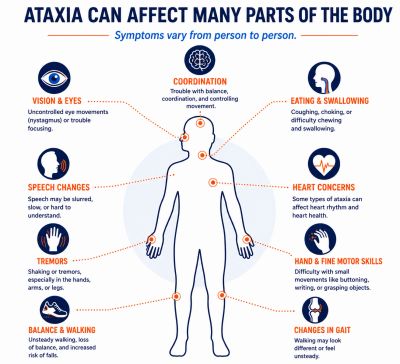
Ataxia can affect people in many different ways. A person may have difficulty walking, speaking clearly, swallowing, using their hands, controlling eye movements, or maintaining balance. Symptoms can begin during childhood or later in adulthood, depending on the type and cause.
Ataxia may progress very slowly over many years or more rapidly. Some people eventually use mobility aids such as canes, walkers, rollators, scooters, or wheelchairs to help them remain safe and independent.
Common Symptoms
Ataxia affects each person differently. Symptoms may include:
- Poor balance or coordination
- Unsteady walking or changes in gait
- Frequent stumbling or falls
- Slurred or difficult speech
- Difficulty swallowing or eating
- Reduced hand and finger coordination
- Tremors or involuntary movements
- Abnormal eye movements
- Changes in vision
- Muscle stiffness or weakness
- Fatigue
- Dizziness or vertigo
Not everyone with ataxia experiences the same symptoms, and the severity and rate of progression can vary greatly.
What Causes Ataxia?
There are many different forms and causes of ataxia. They are generally grouped into hereditary, acquired, and sporadic forms.
Hereditary Ataxia
Hereditary ataxias are caused by genetic changes that can be passed through families. Different forms follow different patterns of inheritance.
Autosomal dominant ataxia: A person generally needs to inherit one altered copy of a gene to develop the condition. When a parent has a disease-causing dominant gene variant, each child typically has a 50% chance of inheriting that variant.
Spinocerebellar ataxias, often called SCAs, are an important group of autosomal dominant ataxias. There are many different SCA types, each associated with particular genetic changes.
Autosomal recessive ataxia: A person generally needs to inherit two altered copies of a gene—one from each parent—to develop the condition. Parents may carry one altered copy without having the disease themselves. Each child typically has a 25% chance of inheriting that variant.
Friedreich Ataxia (FA) is one well-known example of a recessively inherited ataxia.
Acquired Ataxia
Some forms of ataxia are not inherited. Instead, they develop because of another medical condition or outside factor.
Possible causes can include:
- Stroke
- Traumatic brain injury
- Certain infections
- Vitamin deficiencies
- Autoimmune disorders
- Exposure to certain toxins or medications
- Heavy or long-term alcohol use
- Some cancers and cancer-related immune responses
In some acquired forms, identifying and treating the underlying cause may improve symptoms or prevent further neurological damage.
Sporadic/Idiopatic Ataxia
Sometimes a person develops progressive ataxia without a known inherited or acquired cause.
Doctors usually investigate genetic, autoimmune, nutritional, toxic, structural, and other possible causes before determining that an ataxia is sporadic.
Ataxia Can Also Be a Symptom
The word ataxia does not always refer to a specific disease.
It can also describe a symptom—loss of coordination or balance caused by another condition. For example, ataxia may occur following a stroke, brain injury, infection, medication reaction, or another neurological disorder.
Because there are many possible causes, determining why someone has ataxia is an important part of diagnosis and treatment.
Living With Ataxia
Ataxia can manifest differently for every person. Some people experience relatively mild symptoms for many years, while others experience greater changes in mobility, speech, coordination, or independence. Even those with the same form of ataxia can be presented differently. Example my speech is much worse than my father.
Source and additional information: National Ataxia Foundation, What Is Ataxia?