What is Ataxia?
Ataxia describes impaired coordination of voluntary movements. The term is also used for a group of neurological disorders that can affect balance, walking, hand movements, speech, swallowing, and eye movements. Ataxia often involves the cerebellum—the part of the brain that helps coordinate movement—or the nerve pathways connected to it.
Symptoms can begin during childhood or adulthood, depending on the type and cause. Some forms progress slowly over many years, while others progress more rapidly, remain relatively stable, or occur in episodes. Some acquired forms may improve when the underlying cause is treated.
Some people use mobility aids such as canes, walkers, rollators, scooters, or wheelchairs to support their safety, independence, and participation in daily life.
Common Symptoms and Associated Difficulties
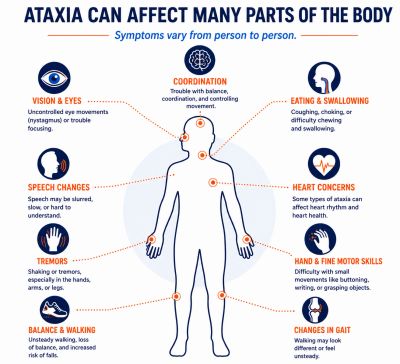
Ataxia affects each person differently. Symptoms vary depending on the type and cause of ataxia, and not everyone experiences all of the following:
- Poor balance or coordination
- Unsteady walking or changes in gait
- Frequent stumbling or falls
- Slurred, slow, or unclear speech (dysarthria)
- Difficulty swallowing (dysphagia)
- Reduced hand and finger coordination, affecting tasks such as eating, buttoning clothing, or using utensils
- Difficulty with rapid, alternating movements, such as brushing teeth, shaking a can, or clapping (dysdiadochokinesia)
- Difficulty writing or changes in handwriting (dysgraphia)
- Difficulty controlling the distance of movements, such as overshooting or undershooting when reaching (dysmetria)
- Drooping upper eyelid (ptosis)
- Excessively watery eyes (epiphora)
- Sensitivity to light (photophobia)
- Abnormal eye movements, including repetitive, involuntary eye movements (nystagmus)
- Tremors or other involuntary movements
- Involuntary muscle contractions causing twisting movements or abnormal postures (dystonia)
- Vision difficulties, such as double or blurred vision, or difficulty judging depth and distances
- Muscle stiffness or weakness
- Fatigue
- Dizziness or a spinning sensation (vertigo)
- Cognitive difficulties (“brain fog”), such as trouble concentrating, finding words, or processing information
- Difficulty regulating emotions (emotional dysregulation)
Does Ataxia Affect Life Expectancy?
Some forms of ataxia can shorten life expectancy, while others are associated with a normal or near-normal lifespan. Examples that can shorten lifespan include Friedreich’s Ataxia (FA), Ataxia-Telangiectasia (AT), certain spinocerebellar ataxias—including SCA1, SCA2, SCA3, and SCA7—and multiple system atrophy cerebellar type (MSA-C). The outlook depends on the specific condition, age at symptom onset, rate of progression, and complications such as heart disease or swallowing and breathing difficulties. A diagnosis of ataxia alone does not determine how long someone will live.
Not everyone with ataxia experiences the same symptoms, and the severity and rate of progression can vary greatly.
What Causes Ataxia?
There are many different forms and causes of ataxia. Ataxia can be described by its cause, family history, and pattern of symptoms. These categories overlap: for example, a genetic ataxia may cause episodic symptoms, and someone with a genetic form may have no known family history.
Hereditary Ataxia
Hereditary ataxias are caused by genetic changes that can be passed through families. Different forms follow different patterns of inheritance.
- Autosomal dominant — One affected parent generally has a 50% chance of passing the variant to each child. Examples include all forms of Spinocerebellar Ataxias (SCAs) and Cerebellar Dysfunction with Variable Cognitive and Behavioral Abnormalities (CECBA/CAMTA1-related disorder).
- Autosomal recessive — A person typically inherits one disease-causing variant in the same gene from each parent. Parents are usually unaffected carriers. When both parents are carriers, each pregnancy has a 25% chance of a child with the condition, Examples include Friedreich’s Ataxia (FA), Ataxia-Telangiectasia (AT), Ataxia with Oculomotor Apraxia type 1 (AOA1) and type 2 (AOA2), Autosomal Recessive Spastic Ataxia of Charlevoix-Saguenay (ARSACS), and Autosomal Recessive Cerebellar Ataxia type 1 (ARCA1).
- Mitochondrial
Acquired Ataxia
Some forms of ataxia are not inherited. Instead, they develop because of another medical condition or outside factor.
Possible causes can include:
- Autoimmune or inflammatory conditions
- Vitamin/nutritional deficiencies
- Alcohol/toxin-related
- Medication-induced
- Infection-related
- Stroke/vascular causes
- Brain injury
- Tumors
In some acquired forms, identifying and treating the underlying cause may improve symptoms or prevent further neurological damage.
Sporadic Ataxia
“Sporadic” means that a person has no apparent family history of the condition. It does not necessarily mean the condition is non-genetic.
Evaluation may identify an acquired cause, a genetic cause, or a degenerative condition or the cause may remain unknown.
Examples:
- Multiple System Atrophy, cerebellar type (MSA-C)
- Some autoimmune or acquired ataxias without a family history
- Some genetic ataxias caused by a new (de novo) variant
Episodic Ataxia
Ataxia that occurs in episodes or attacks, with symptoms improving or sometimes disappearing between episodes.
Examples:
- Episodic Ataxia Type 1 (EA1)
- Episodic Ataxia Type 2 (EA2)
- Other rarer episodic ataxia types
- Episodes may be triggered by exercise, stress, illness, caffeine, alcohol, or other factors depending on the type.
Idiopathic Ataxia (about 20% of all ataxias)
Ataxia in which the underlying cause remains unknown after medical evaluation and testing. As testing improves, some people originally diagnosed with idiopathic ataxia may later receive a specific diagnosis.
Examples:
- Idiopathic Late-Onset Cerebellar Ataxia (ILOCA)
- Sporadic Adult-Onset Ataxia of Unknown Etiology (SAOA)
- Unexplained progressive cerebellar ataxia
Living With Ataxia
Ataxia affects each person differently. Some people experience relatively mild symptoms for many years, while others experience greater changes in mobility, speech, coordination, or independence. Even people with the same genetic form—including members of the same family—can have different symptoms and rates of progression. For example, my speech is more affected than my father’s was at the same age.”
Many inherited and degenerative forms currently have no cure. Unfortunately, now there is no cure and SOME types have medication to treat symptoms and/or prolong life expectancy, but nothing to STOP the disease from progressing. However, treatment may help manage symptoms, and treatments for certain conditions can improve function or slow progression. Some acquired forms may improve or resolve when the underlying cause is treated.
Estimated USA Population Affected: About 150,000 which is <1%
Estimated World Population Affected: About 1 million which is <1%
Source and additional information: National Ataxia Foundation
Terminology

Ataxia: Disease, Disorder, or Condition
The terminology surrounding ataxia can be confusing because the word can have different meanings depending on how it is used. One helpful distinction is between Ataxia with a capital “A” and ataxia with a lowercase “a.”
Ataxia (capital “A”) can be used informally as an umbrella term for a group of neurological diseases and disorders in which problems with coordination and balance are a primary feature. This includes genetic (inherited/hereditary) Ataxias, such as Friedreich's Ataxia (FA) and the Spinocerebellar Ataxias (SCAs), as well as non-genetic forms of Ataxia.
ataxia (lowercase “a”) can be used as a general medical term describing a neurological condition involving impaired coordination and balance.
The words disease, disorder, and condition may all be used when discussing ataxia. Disease generally refers to a specific medical diagnosis, disorder describes a disruption of normal neurological function, and condition is a broader term that can encompass either. The most appropriate term depends on the type of ataxia and the context in which it is being discussed.
Disease: A specific medical diagnosis involving an identifiable disease process. Its cause may be genetic or non-genetic, but the originating factor is known.
Disorder: A disruption of normal body or neurological function. The underlying cause may also be known or unknown.
Condition: A broad, neutral term used to describe a person's health or medical state and can include both diseases and disorders.
These terms often overlap, and there is no strict medical rule requiring every type of ataxia to be described using only one of them.
*Capitalizing Ataxia is a useful educational convention, not an official medical rule. Medical publications often use lowercase ataxia even when discussing specific ataxia diseases and disorders.
ataxia can also be a Symptom, Sign and/or Impairment
In addition to describing a disease, disorder, or condition, ataxia can also be described as a symptom, sign, or impairment depending on the context and who is describing it. These terms are related, but they have different meanings.
Symptom: ataxia can be a symptom experienced by a person, such as feeling unsteady, having difficulty coordinating movements, or noticing changes in speech or balance. Symptoms are generally what a person feels, notices, or reports.
Sign: ataxia can be a clinical sign observed or measured by a healthcare professional. For example, a neurologist may observe an unsteady gait, difficulty performing coordinated movements, or abnormalities during a neurological examination.
Impairment: ataxia can result in an impairment of neurological or physical function, such as reduced coordination, balance, fine motor control, speech, or eye movement. An impairment describes how a person's ability to perform a particular body function is affected.
A simple way to remember the difference is:
Symptom: what you experience
Sign: what can be observed or measured
Impairment: the function that is affected
The same problem can sometimes fall into more than one category. For example, a person may feel unsteady (symptom), a neurologist may observe an unsteady gait (sign), and testing may demonstrate impaired balance and coordination (impairment).
Progressive vs. Degenerative
The words progressive and degenerative are often used when discussing ataxia, BUT they describe different aspects of a condition.
Progressive: A progressive ataxia is one in which symptoms and functional difficulties tend to increase or change over time. Progression can be slow or fast and may vary greatly from one person to another.
Degenerative: A degenerative ataxia involves an ongoing dysfunction and/or loss of cells or structures in the nervous system, often affecting the cerebellum and its connections. The term describes what is happening biologically within the nervous system rather than simply how a person's symptoms change.
A simple way to remember the difference:
Progressive: how the condition changes over time.
Degenerative: what is happening to the nervous system.
Many inherited ataxias are both progressive AND degenerative, but the terms should not automatically be used for every type of ataxia. Some ataxias can be temporary, episodic, acquired, treatable, or relatively stable.
Dominant vs. Recessive Ataxia
Many genetic Ataxias are inherited in either an autosomal dominant or autosomal recessive pattern. The difference is based on how many altered copies of a gene are needed to cause the disease and how they are inherited.
Autosomal Dominant Ataxia: A person generally needs only one altered copy of the gene to develop the condition. The altered gene can be inherited from either parent.
If one parent has an autosomal dominant ataxia and the other parent does not carry the disease-causing variant, each child has:
50% chance of inheriting the altered gene. Spinocerebellar Ataxias, often called SCAs, are an important group of autosomal dominant Ataxias. There are many different SCA types, each associated with particular genetic changes.
Autosomal Recessive Ataxia: A person generally needs two altered copies of the same gene—one inherited from each parent—to develop the condition. Parents who have only one altered copy are typically called carriers and usually do not develop a condition.
When both parents are carriers of the same autosomal recessive condition, each child has:
25% chance of having the condition
50% chance of being a carrier
Friedreich's Ataxia (FA) is one well-known example of a recessively inherited ataxia.
The probability is the same for every pregnancy, regardless of what happened with previous children.
*These percentages describe the classic autosomal inheritance patterns, not every genetic Ataxia. Some Ataxias are X-linked, mitochondrial, caused by de novo variants, or have other inheritance patterns, so a person's actual genetic risk depends on the specific diagnosis and family genetics.
Atrophy vs. Dystrophy
Atrophy and dystrophy are different. Atrophy means that tissue becomes smaller or loses mass. In some forms of ataxia, this can occur in the cerebellum of the brain or other parts of the nervous system, which may be seen on an MRI as cerebellar atrophy. Muscles can also develop disuse atrophy when they are not used regularly (“use it or lose it”).
Dystrophy refers to abnormal development, maintenance, or deterioration of tissue and is most commonly associated with muscle diseases, such as muscular dystrophy. ATAXIA ITSELF IS NOT DYSTROPHY. In most forms of ataxia, the primary problem involves the nervous system's ability to coordinate movement rather than a primary disease of the muscles.
Atrophy: tissue becomes smaller or loses mass.
Dystrophy: tissue develops, functions, or is maintained abnormally.
Things to Know

Blue Ribbon
It represents hope, strength, and solidarity for people living with ataxia and their families. It helps raise awareness of ataxia while supporting greater understanding, research, advocacy, and ultimately the search for treatments and cures.
Zebra
It represents rare diseases, inspired by the medical saying, “When you hear hoofbeats, think horses, not zebras.” For people with rare conditions like many forms of ataxia, the zebra symbolizes being rare, unique, and deserving of recognition, accurate diagnosis, research, and support.
International Symbol of Access
The familiar wheelchair symbol represents accessibility and identifies spaces, services, and features designed to be accessible to disabled people.